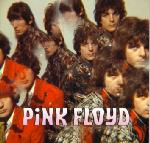
Release date:
August 5th, 1967
The Floyd's growing underground popularity led to a single,
"Arnold Layne," released in March of 1967. It entered
the British charts at #20, resulting in national media exposure
for the band. Their followup single, "See Emily Play,"
stayed on the charts for 7 weeks, reaching #6. The Pink Floyd's
first LP, The Piper at the Gates of Dawn, also remained on the
charts for 7 weeks, and also reached #6.
Despite being over 24 years old, the Floyd's debut release still sounds as fresh as ever (in marked contrast to its famous contemporary "Sgt. Pepper"), and was Britain's enduring contribution to the Summer of Love. In early 1967 Pink Floyd went into EMI's Abbey Road studios with a stack of whimsical tunes about gnomes, scarecrows and bikes, psychedelic ditties that bore only a passing resemblance to the prostracted spacey jams they were then famous for. The result was an unique combination of English whimsy and avant-garde sounds, featuring studio versions of the Floyd's most supremely psychedelic songs, the underground anthems "Astronomy Domine" and "Interstellar Overdrive". Two things in particular stand out: Rick Wright's strange ethereal organ sound and the sheer power and magic of Syd Barrett's songwriting--he wrote or co-wrote 10 of the 11 songs present -- and guitar playing.
Nick Mason: "We were given Norman Smith by EMI, no arguments. So Joe Boyd, our original producer, got written out of the thing. Norman was more interested in making us sound like a classical rock band. It was a bit like the George Martin thing, a useful influence to have. But I think Joe would have given Syd his head, let him run in a freer way. We spent three months recording it, which was quite a long time in those days. Bands used to have to finish albums in a week, with session players brought in to play the difficult bits. But because The Beatles were taking their time recording Sgt Pepper in the studio next door, EMI thought this was the way people now made records. We were taken in to meet them once, while they were recording Lovely Rita. It was a bit like meeting the Royal family."
Former manager Peter Jenner: "Norman was being the perfect A&R man. He realized Syd could write great pop songs. If we'd put out what we were playing live, it wouldn't have sold fuck at all. The one song here that was like the live shows was Interstellar Overdrive. They played it twice, one version recorded straight on top of the other. They doubletracked the whole track. Why? Well it sounds pretty fucking weird doesn't it? That big sound and all those hammering drums."
The album's title comes from the the seventh
chapter of Kenneth Grahame's "The Wind in the Willows"
(the book was a favorite of Syd's).
Tracks:
Total Playing Time: 41'58
Musicians Featured: